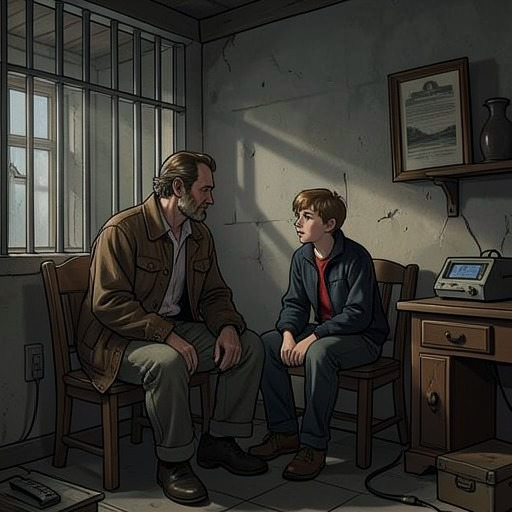
I hope that nobody has ever had to look at anybody they love through glass.
If Beale Street Could Talk“I hope that nobody has ever had to look at anybody they love through glass.” gives a precise, intimate form to the separation between Tish and Fonny: they can see one another, but a prison barrier governs how they meet and speak. The expression’s force extends beyond the visit itself, linking a loving relationship to the corridors, journeys, and confinement through which incarceration isolates them both.
The Visit and the Barrier
Tish and Fonny sit on benches facing one another, with glass between them. Sound cannot pass through it, so they speak by telephone. The arrangement makes looking an effort as well as a necessity: people tend to look down while using the phone, but Tish has learned to hold it and keep her eyes on Fonny. She loves his eyes and fears that every visit might be the last time she sees him. When she calls his name, he first looks down, then up, smiles, and waits with the phone in his hand.
The sentence follows this concrete scene, where the glass is not a metaphor invented at a distance but the material condition of contact. Tish has something difficult to tell Fonny. She wants to say it casually, without accusation, and does not want to add to his worry; she also knows he has to hear it. She imagines that once his immediate anxiety has passed, he may be glad. The barrier therefore frames a careful act of communication: her love is present in the effort to manage what he must hear and how he receives it, even though she cannot remove the conditions under which they speak.
From the Visiting Room to the City
The glass belongs to a larger geography of confinement. After leaving, Tish crosses broad corridors she has come to hate, comparing their apparent vastness to the Sahara. Her image turns the corridors into a landscape of exposure: in the desert, vultures wait for the fallen, while lawyers, bondsmen, and others circle poor people caught in the legal system. The comparison enlarges the visit’s separation into an account of the institutions and economic pressures surrounding imprisonment. Tish rejects the shame borne by families whose loved ones are jailed and insists that the people responsible for the jails are the ones who should be ashamed.
On another journey home, Tish takes the bus because it is slower and she has a great deal on her mind. Trouble leaves her moving through ordinary routines while feeling detached from other people; at the same time, she notices them with an unfamiliar sharpness. She cannot simply tell a stranger that Fonny is in jail, that she believes he is innocent, and that she fears for him and for the child she is carrying. The narration condenses this isolation in the sentence “Trouble means you're alone.” The line about looking through glass thus resonates beyond the visiting room: separation reaches into Tish’s daily movement and limits what she can ask of the people around her.
Confinement and the Struggle to Endure
Fonny’s prison spaces give the image of separation a harsher physical counterpart. At first he is held alone in a provisional cell near the top of the prison, with a foul-smelling toilet in the corner; he cannot tell the time, and the hours and days seem alike. He is afraid of remaining alone and also afraid of being moved among other men. The glass separates visitors from prisoners, while the cell and its routines constrain Fonny’s body and sense of time from within.
Later, Fonny is placed in solitary for refusing to be raped. He loses a tooth and almost loses an eye; the experience changes him, but he begins to fight for his life, holding the prospect of his baby’s arrival before him. Tish brings him books, and they obtain paper for him to sketch. Their contact and shared concern cannot dissolve the prison’s barriers, but they preserve forms of connection across them. The expression’s significance lies in that tension: the glass makes separation visible, while the continued acts of looking, visiting, bringing books, and imagining a future insist that love persists within the limits imposed by confinement.
Narrative Significance
The sentence moves from a particular encounter to a broader pattern without making the two kinds of separation interchangeable. In the visiting room, Tish and Fonny can see each other and speak through phones; elsewhere, the corridors, the bus, the cell, and solitary confinement extend the prison’s effects into movement, communication, and time. The narrative grounds its social critique in these specific obstacles rather than treating incarceration as an abstraction.
The expression also balances fear with care. Tish’s fear that she may never see Fonny again accompanies her deliberate attention to his face and her effort to protect him from further worry. Fonny’s later resolve to endure prison for the sake of seeing his baby gives that attention a future-facing counterpart. The line does not promise that the barrier will fall; it makes the human cost of looking across it impossible to overlook.